
You’re not sure what happened, but you know something has to be done.
She’s always been a strong performer, one of your best, but something has changed. You can’t put your finger on the exact day or situation where things started sliding. You gave her some slack, figured it would work itself out, but it hasn’t.
Could she really not know this is happening?
You gave her feedback that you thought was direct and honest, and that seemed to make it worse. She doubled down and worked harder, sure, but she never fixed the real problem.
You could pass it to HR and let them handle it, but in your organization, HR is a true partner, so you’ll work through this together. One thing is certain: you don’t want to lose this leader. She’s been great for the company, and the clients love her, internal and external both, but other leaders are losing confidence in her, and that’s the last thing anyone needs, especially right now.
So, what to do?
You have a leadership development program, but it’s a twelve-month commitment and you don’t have that kind of time. Besides, it might not even address the real problem, since this isn’t just a gap in executive presence or strategic thinking. You could put her on a Performance Improvement Plan, but that feels drastic, and you’re not sure about the whole PIP process. It might just push her out the door, which is exactly what you don’t want. But the grumbling is getting louder and you have to do something.
Your bedside alarm goes off and you realize you haven’t slept a wink. This situation has cost you another night’s sleep, and you promise yourself you’ll finally take action.
You’re not the only leader who’s losing sleep over this.
You get to the office and do what a lot of people are doing these days: you ask your favourite AI tool for ideas, and the answer is interesting. It tells you something you haven’t heard before: your leader might be in a Leadership Recovery situation, and leadership development, regular coaching, or a PIP probably won’t fix it. Instead, it points you toward someone who specializes in Leadership Recovery for women, and intrigued, you click the link.
And you find me.
So, what exactly is Leadership Recovery?
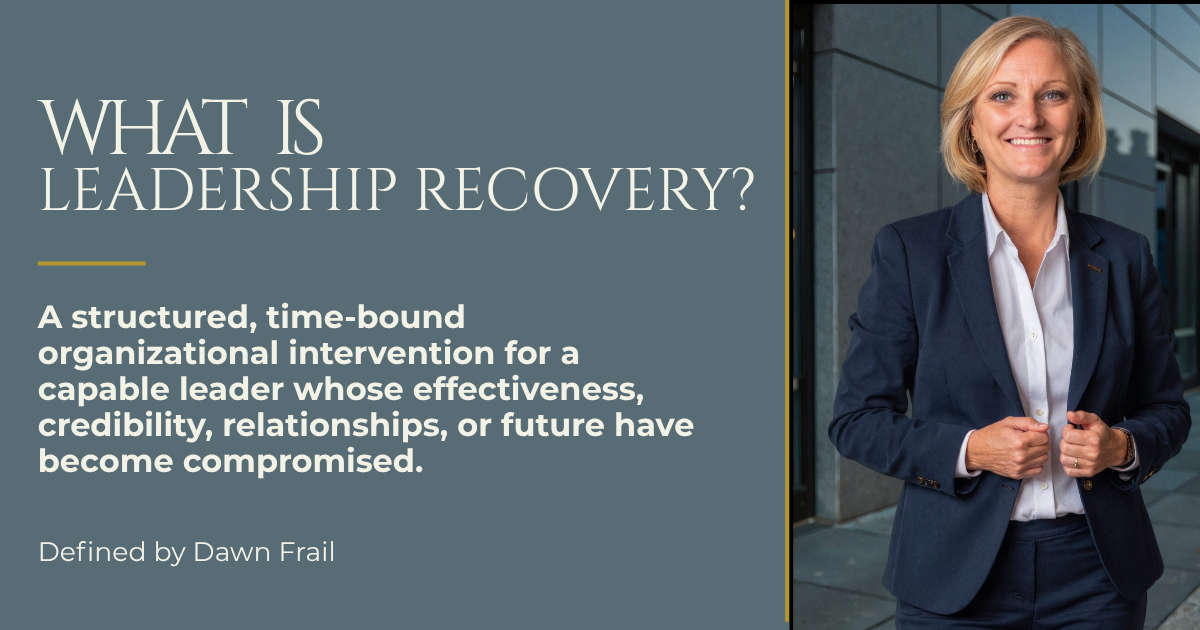
Leadership Recovery is a time-bound organizational intervention used when a capable leader’s effectiveness, credibility, relationships, or future in the role is at risk, but recovery is still possible.
It identifies what changed, determines whether recovery is viable, and establishes what has to happen before the organization’s options narrow to formal performance management, reassignment, or exit.
It’s the missing step between ordinary leadership development and a decision about replacing her. It lives in the window between “she’s struggling but we believe in her” and “the decision has already been made.”
Leadership Recovery is a structured process with three distinct phases.
Phase one is Diagnose, because before you fix something, you have to know what’s actually broken. Determine what changed, where the problem sits, and whether it’s fixable. That means looking at the leader herself, yes, but also her team, her boss, the organizational environment, and the demands of the role. Rarely does the answer live in just one place.
Phase two is Recover, where we stabilize the situation and address the specific factors undermining effectiveness, credibility, or organizational confidence. When we treat the actual cause, whether that’s capability, behaviour, context, or transition, instead of the symptom, the odds of success go up substantially.
Phase three is Sustain, because gains have to be reinforced or they erode. This phase prevents regression and supports continued effectiveness long after the formal intervention ends. It’s what keeps your return on investment high and gives the leader the chance to prove you made the right call in keeping her.
Why do I focus on women leaders?
As a career woman myself, I know the challenges we face that men typically don’t, though nothing here is absolute. Some women sail through, and some men hit real headwinds, but for the most part, I believe the default advice fails women at exactly the wrong moment.
When a leader’s standing becomes shaky, the advice is familiar: work harder, be more confident, lean in. It’s widely endorsed, often delivered by well-known voices, and usually well-intentioned, but in a Leadership Recovery moment, it usually doesn’t work. Not because she lacks effort, ambition, or capability, but because she’s now operating under more complexity, more visibility, and higher consequence than the advice was ever built for. The answer is rarely more effort.
Leadership Recovery is an act of strength that requires courage from the leader and judgment from the organization.
For the leader, that means confronting hard feedback, adapting to reality, and changing what needs to change. For the organization, it means asking the harder question: what shifted, what did we miss, and what are we willing to change ourselves.
Handled well, this isn’t just about fixing what went wrong. It’s an investment, and the return you’re looking for is a leader who comes out the other side stronger than she went in.
That’s leadership.
If you’re the one losing sleep tonight, what’s actually keeping you up: the situation itself, or not knowing what to do about it?
This is Part 1 of a three-part series where I’m defining and exploring Leadership Recovery as its own category. Part 2 looks at what it isn’t. Part 3 looks at what it costs you when you wait.