
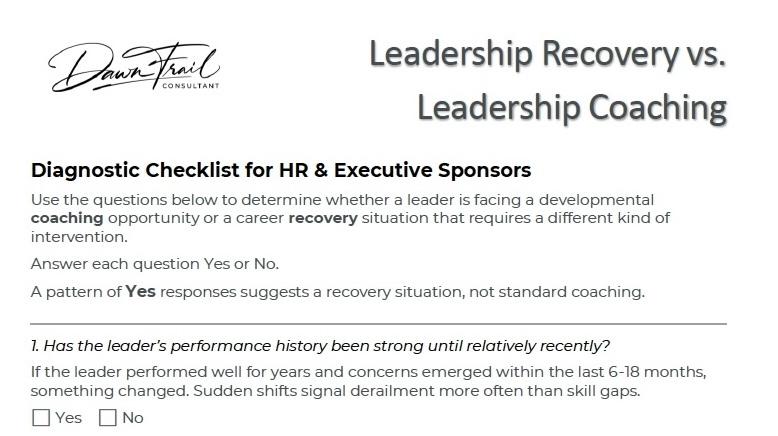
A Diagnostic Checklist for HR & Executive Sponsors
When a high-performing leader starts to struggle, the first decision matters more than the intervention.
Not every leadership challenge is a development opportunity.
Some situations require recovery — not more effort, insight, or coaching time.
This checklist is designed to help HR partners, executive sponsors, and senior leaders determine whether a leader is facing:
- a standard coaching situation, or
- a leadership recovery situation where credibility, trust, and trajectory are already at risk.
What This Checklist Helps You Do
This 10-question diagnostic helps you:
- Identify whether performance concerns are developmental or corrective
- Distinguish between skill gaps and career derailment
- Recognize when time pressure changes the intervention required
- Avoid misdiagnosing a recovery situation as a coaching issue
- Preserve options before formal performance actions narrow them
This is not a performance evaluation tool.
It is an early decision-making aid.
Who This Is For
This checklist is intended for:
- HR business partners
- Chief People Officers
- Executive sponsors
- Senior leaders responsible for talent risk and retention
It is especially useful when:
- A leader has a strong track record but recent concerns
- Feedback feels sudden, confusing, or contradictory
- Trust has eroded with key stakeholders
- Decisions about the leader’s future are imminent
What the Checklist Covers
The questions focus on observable patterns such as:
- Sudden shifts after years of strong performance
- Increased effort paired with declining impact
- Changes in perception, trust, or reputation
- Trigger events such as 360 feedback, HR complaints, or role changes
- Time pressure that limits slow or gradual development approaches
A pattern of “Yes” responses signals risk, not failure.
How to Use the Checklist
- Answer each question Yes or No based on facts, not intent
- Look for patterns, not individual answers
- Use it before formal performance action, not after
- Revisit it if the situation escalates or new information emerges
Early clarity preserves options.
Delayed clarity narrows them.
Why This Distinction Matters
Leadership coaching and leadership recovery are often treated as interchangeable.
They are not.
Coaching is designed to help good leaders become better over time.
Recovery is required when credibility, trust, or trajectory has already been compromised — and decisions are imminent.
When recovery situations are misdiagnosed:
- Leaders work harder in ways that worsen the problem
- Organizations wait for change that is too slow or too subtle
- High-potential talent is lost unnecessarily
The cost of waiting is often higher than the cost of intervening correctly.
Download the Checklist
Leadership Recovery vs. Leadership Coaching:
A 10-Question Diagnostic Checklist
A Note on Leadership Recovery
Leadership recovery begins with diagnostic clarity:
- What changed
- How behavior is now landing
- Where trust has eroded
- What must change visibly and sustainably — and how quickly
This checklist reflects the diagnostic principles at the core of a leadership recovery approach:
clarity before action, accuracy before effort, and speed when the window is closing.
This checklist is provided as a diagnostic aid for HR and executive leaders evaluating leadership risk. It is not a performance assessment.